SUGGESTED HCPC: L3980
ORDER NUMBER: 73003, 73005, 73007, 73008
SIZE: Small - X Large
PRODUCT HIGHLIGHTS:
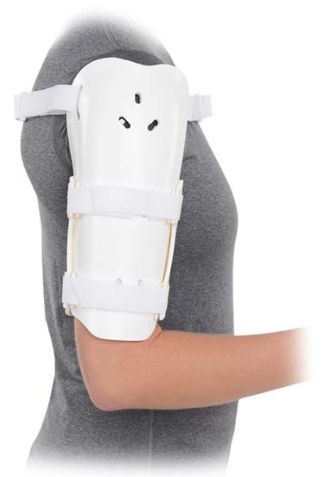
• Features a deltoid cap extension which helps provide greater alignment control and prevents distal slippage
• Neutral design utilizes a two piece, foam lined clamshell providing superior compression to the fracture sight
• Complete with two double thickness cotton stockinette
A Humeral Fracture Brace (Shoulder) — often called a Functional Humeral Fracture Orthosis (HFO) or Sarmiento brace — is an orthopedic device designed to stabilize and support the humerus (upper arm bone) following a fracture, while allowing controlled movement at the shoulder and elbow to promote natural healing and prevent stiffness.
Here’s a breakdown of its key features, indications, and clinical benefits:
🦴 Purpose
- To immobilize and align the humerus after mid-shaft or distal-shaft fractures.
- To maintain fracture alignment through circumferential compression.
- To allow functional movement of the shoulder and elbow during recovery.
⚕️ Indications
- Closed humeral shaft fractures (mid or distal third)
- Post-operative use after ORIF (Open Reduction Internal Fixation) or external fixation removal
- Stable fractures managed conservatively
- Pathological fractures (depending on stability and pain control)
🚫 Contraindications
- Open fractures with extensive soft-tissue injury
- Unstable proximal fractures involving the shoulder joint
- Segmental or comminuted fractures needing surgical fixation
- Severe edema or compromised circulation
🩹 Design & Components
- Lightweight thermoplastic shell (anterior and posterior)
- Velcro straps for adjustable compression
- Shoulder cap or extension to secure the brace proximally
- Liner or stockinette underneath for comfort and skin protection
💪 Advantages
- Promotes early mobility of adjacent joints
- Enhances functional recovery and prevents stiffness
- Provides uniform compression around the soft tissue
- Can be adjusted as swelling subsides
- Avoids surgical risks in appropriate cases
🩼 Fitting & Care Instructions
- Must be applied by a trained clinician
- Worn continuously, typically 6–8 weeks, depending on healing
- Regular follow-up and radiographic assessment required
- Maintain skin hygiene and inspect for irritation or sores
- Tighten straps daily to maintain compression