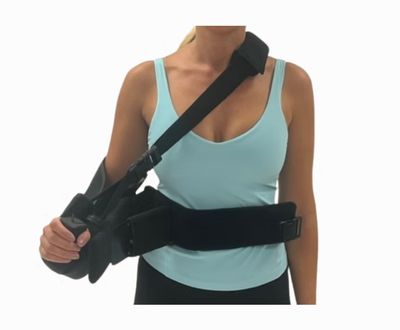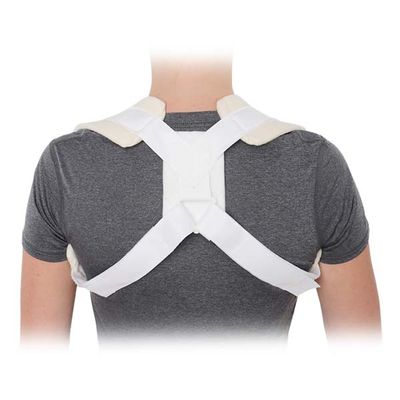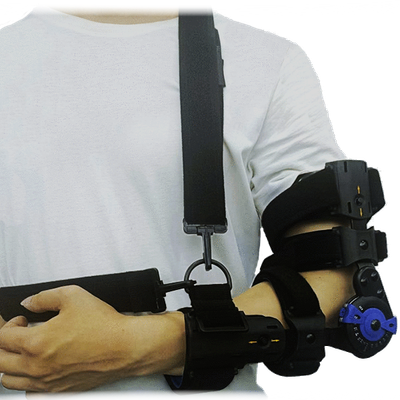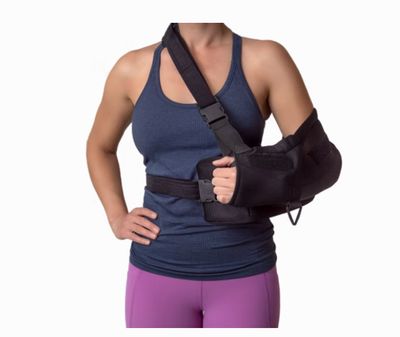
Orthopedic (ortho) braces are medical devices designed to support, align, stabilize, or protect muscles, joints, and bones, typically after injury or surgery. These braces can help with recovery by limiting movement, providing compression, and offering structural support to reduce stress on the affected area. They come in various types, each tailored to specific injuries or conditions. Here are some key categories of orthopedic braces:
1. Knee Braces
– Function: Provide support to the knee joint, often used for conditions like arthritis, ACL tears, meniscus injuries, or after surgery.
– Types:
– Hinged braces: Offer more rigid support and restrict side-to-side movement.
– Compression sleeves: Provide mild support, improving blood flow and reducing swelling.
2. Back Braces
– Function: Stabilize and support the lumbar or thoracic spine, commonly used for conditions like scoliosis, herniated discs, or after spinal surgery.
– Types:
– Rigid braces: Limit spinal movement and offer significant support.
– Flexible braces: Allow some movement while providing mild support and pain relief.
3. Ankle Braces
– Function: Stabilize the ankle joint after sprains or ligament injuries.
– Types:
– Lace-up braces: Provide adjustable compression and stability.
– Rigid braces: Offer maximum support to prevent any movement.
4. Wrist and Hand Braces
– Function: Immobilize or support the wrist and hand, commonly used for carpal tunnel syndrome, wrist fractures, or tendonitis.
– Types:
– Splints: Rigid or semi-rigid braces that limit movement.
– Compression braces: Provide support without fully restricting movement.
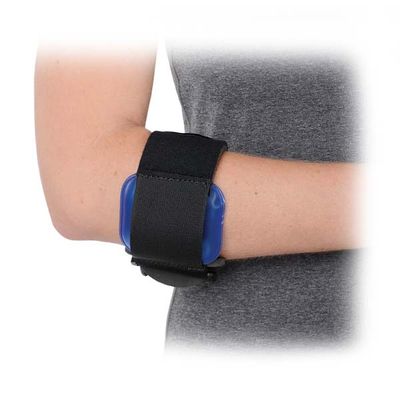
5. Elbow Braces
– Function: Support the elbow joint, often used for conditions like tennis elbow or golfer’s elbow.
– Types:
– Strap braces: Target compression to relieve tendon strain.
– Hinged braces: Offer greater support and restrict specific movements.
Materials
Orthopedic braces are typically made from a combination of materials, including:
– Neoprene: For elasticity and compression.
– Nylon or Polyester: For durability and flexibility.
– Plastic or Metal: For rigid components that provide structural support.
– Foam Padding: For comfort and cushioning against the skin.
Usage
Orthopedic braces are used in a wide range of cases:
– Post-surgical recovery: To stabilize the area while healing.
– Injury prevention: For athletes to protect vulnerable joints during high-risk activities.
– Chronic conditions: Such as osteoarthritis or rheumatoid arthritis, where joints require ongoing support.
Custom vs. Off-the-Shelf Braces
– Custom braces: Made to fit an individual’s specific anatomy, offering the highest level of support and comfort.
– Off-the-shelf braces: Available in standard sizes and are generally more affordable and convenient but may not provide the perfect fit or maximum support.
These devices help manage pain, facilitate healing, and allow patients to remain active while recovering from injuries.
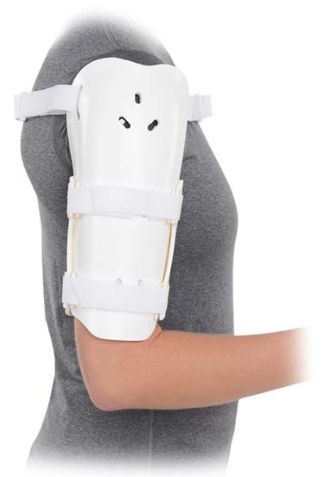
Humeral Fracture Brace (Shoulder). Suggested HCPC: L3980
SUGGESTED HCPC: L3980
ORDER NUMBER: 73003, 73005, 73007, 73008
SIZE: Small - X Large
PRODUCT HIGHLIGHTS:
• Features a deltoid cap extension which helps provide greater alignment control and prevents distal slippage
• Neutral design utilizes a two piece, foam lined clamshell providing superior compression to the fracture sight
• Complete with two double thickness cotton stockinette
A Humeral Fracture Brace (Shoulder) — often called a Functional Humeral Fracture Orthosis (HFO) or Sarmiento brace — is an orthopedic device designed to stabilize and support the humerus (upper arm bone) following a fracture, while allowing controlled movement at the shoulder and elbow to promote natural healing and prevent stiffness.
Here’s a breakdown of its key features, indications, and clinical benefits:
🦴 Purpose
- To immobilize and align the humerus after mid-shaft or distal-shaft fractures.
- To maintain fracture alignment through circumferential compression.
- To allow functional movement of the shoulder and elbow during recovery.
⚕️ Indications
- Closed humeral shaft fractures (mid or distal third)
- Post-operative use after ORIF (Open Reduction Internal Fixation) or external fixation removal
- Stable fractures managed conservatively
- Pathological fractures (depending on stability and pain control)
🚫 Contraindications
- Open fractures with extensive soft-tissue injury
- Unstable proximal fractures involving the shoulder joint
- Segmental or comminuted fractures needing surgical fixation
- Severe edema or compromised circulation
🩹 Design & Components
- Lightweight thermoplastic shell (anterior and posterior)
- Velcro straps for adjustable compression
- Shoulder cap or extension to secure the brace proximally
- Liner or stockinette underneath for comfort and skin protection
💪 Advantages
- Promotes early mobility of adjacent joints
- Enhances functional recovery and prevents stiffness
- Provides uniform compression around the soft tissue
- Can be adjusted as swelling subsides
- Avoids surgical risks in appropriate cases
🩼 Fitting & Care Instructions
- Must be applied by a trained clinician
- Worn continuously, typically 6–8 weeks, depending on healing
- Regular follow-up and radiographic assessment required
- Maintain skin hygiene and inspect for irritation or sores
- Tighten straps daily to maintain compression